
(Bob Barratt)
 Australian artist, recorded in UK
Original version
Single on Columbia January 1963 by Australian singer, dancer and actress (1944-2021) born to Sydney theatrical figures Buster Noble and Helen de Paul.
Patsy Ann Noble was a teenage star of national TV pop show Bandstand and was signed by His Master’s Voice for a number of singles of which Good Lookin’ Boy was the most successful.
After moving to Britain in 1962 she released further singles on EMI’s Columbia label without commercial success. However, from childhood she had appeared in theatrical productions in Sydney, and in Britain she was increasingly seen in cinema and TV acting roles. Her acting career flourished from the mid-60s in the USA where she became known as Trisha Noble.
The writer
Bob Barrett (1938-2004) was a long-serving producer, A&R man and songwriter at EMI where he started work in his youth with major producer Norman Newell. He is often mentioned in connection with producing The Wurzels’ records including their biggest hit Combine Harvester. He established the Grasmere label in the 80s, featuring brass bands and organ music.
Many thanks to Philippe for suggestion and list of versions.
(Bob Barratt - Gérard Bourgeois - Jean-Max Rivière ) France
Original version with these lyrics
On Philips EP Un jour comme un autre January 1964 by Jean-Max Rivière (1937-2025) one of the French-language lyricists on the song. Ça pourrait changer = That could change.
Another songwriting partner of Rivière’s was Claude Bolling , musical director and conductor on Brigitte Bardot’s first album.
(Bob Barratt - Gérard Bourgeois - Jean-Max Rivière ) France
Later version
#37 France
On Philips EP Ça pourrait changer January 1964 by Brigitte Bardot (1934-2025), the unique and influential legend of French cinema, music and style, recognised and adored worldwide. Also on album B.B. (1964).
When Bardot released her first album Brigitte Bardot (or Brigitte Bardot Sings) in 1963, her successful film career was already well established. Her appearance in 1957’s Et dieu… créa la femme (And God Created Woman) was not her first, but it had been a breakthrough, a critical and commercial success internationally as well as in France.
The credits on her first album include some names that would appear on subsequent Brigitte Bardot albums including songwriters Jean-Max Rivière and Gérard Bourgeois (who adapted Ça Pourrait Changer from Don’t You Ever Change Your Mind) and Serge Gainsbourg, a notable collaborator including on the problematic Je t’aime moi non plus (1967, rel. 1986).
(Bob Barratt - Gérard Bourgeois - Jean-Max Rivière ) Australian artist, recorded in France
Later version
On Présence Mondiale EP Il est là, le garçon recorded by the original artist at the famous Pathé-Marconi Studios in Boulogne-sur-Seine in the Paris metropolitan area.
Two other songs adapted for the EP were co-written by Bob Barratt, one each with Norrie Paramor and Raymond Dutch.
♫ Listen at YouTube
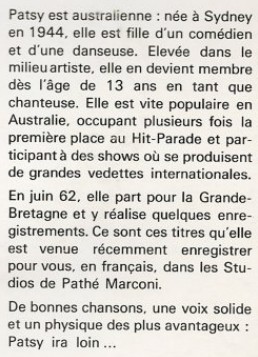
The liner notes [via Google Translate and Reverso]:
Patsy is Australian: born in Sydney in 1944. She is the daughter of an actor and a dancer. Raised in the artistic world, she became a member of it at the age of 13, as a singer. She quickly became popular in Australia, reaching the top of the charts several times* and participating in shows featuring major international stars. In June 1962, she went to Great Britain and made some recordings there. These are the songs she recently came to record for you, in French, at the Pathé Marconi Studios. Good songs, a strong voice, and a very attractive appearance: Patsy is destined for great things.
*In fact, near the top of the charts, once.
I
(Bob Barratt - Gérard Bourgeois - Jean-Max Rivière ) Canada
Later version
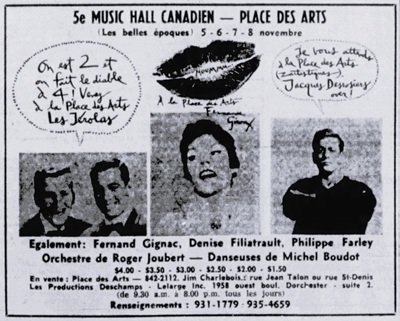
B-side on Select March 1964 by Philippe Farley (1940-1982), pop-rock singer and journalist from Sorel, Quebec. He left the music business in 1967 after releasing four singles 1963-1965.
Farley wrote a column in celebrity magazine Photo Vedettes called “Ça pourrait changer” after the title of this song.
Essential reading: Monsieur Jeff’s page on Philippe Farley at monsieurjeff.ca has a biography and numerous press clippings.
(Dave Dee - Peter Mason) UK
Red herring
 Same title but not the same song as “Don’t You Ever Change Your Mind” by Patsy Ann Noble.
B-side on Philips by member (b. 1943) of 60s hitmakers Dave Dee, Dozy, Beaky, Mick & Tich.
 Pop Archives
Australia's premier song history site since 2004
Website by Lyn Nuttall. © Lyn Nuttall 2004-2026. Chart positions courtesy of Gavin Ryan’s Australian Chart Books and Dean Scapolo’s Complete NZ Music Charts. Special thanks to Terry Stacey for information, corrections and suggestions. Thanks also to Tony Watson, Philippe Edouard, Dave Overett.., More…