(Gordon Haskell) Australia
#4 Brisbane #18 Sydney
Single on Festival by innovative and influential Sydney jazz-rock big band that emerged from The Heart And Soul, formed in Sydney in 1967 (see their 1968 single Who Could Be Loving You).
The singer is Graeme Willington. Band keyboardist Rory Thomas produced the record.
Essential reading: 1. The band’s French horn player and trumpeter Philip Prideaux has posted a detailed page of Heart ‘n’ Soul information, clippings, posters and photos, plus a music page that features a playable list of interesting tracks from a variety of sources. 2. Milesago has a full band history including data on personnel and releases.
Thanks to Tertius Louw for his help with sorting this page. Any remaining confusion is mine, not his.
(Gordon Haskell) South Africa
Influential version
#1 South Africa #1 Rhodesia
Single on Troubadour Prestige.
Quentin E. Klopjaeger was a pseudonym of frequently charting South African singer-songwriter-producer William Boardman, best known as Billy Forrest but sometimes working under other names.
Although Billy Forrest/Quentin E. Klopjaeger released records in the early 70s using the name William E, he is not the William E who recorded the original version of Lazy Life (see below).
Billy Forrest brought Lazy Life back from London where he’d gone as one half of the popular South African folk-pop duo The Dream Merchants. They had been set to record with British Decca but as a result of British Equity’s policies against apartheid they were refused work visas.
Albert Rossi, studio drummer at Troubadour Records recalls: Billy [gave] us musicians all a copy of the UK version of this number to take home and listen to and to let him know what we thought. (Comment at Garage Hangover.)
Because of the early participation of Durban band The Gonks, first pressings showed the artists as Quentin E. Klopjaeger & The Gonks. The label credits A Billy Forrest Production.
The recording of Lazy Life started out as a session with The Gonks, produced by Billy Forrest. The Gonks did not go ahead with the project, but the completed backing track was used in the final release.
It may not be as straightforward as that. At Garage Hangover, Rod Aitcheson of The Gonks and Troubadour Studios session drummer Albert Rossi (among others) have discussed the recording process and studio personnel, while trying to clear up some loose threads in the story.
Further reading: 1. The Gonks at Garage Hangover. Don’t skip the comments thread. 2. The Billy Forrest blog by Tertius Louw and Brian Currin collects more information than you’ll find anywhere else, and includes contributions by Billy Forrest himself. 3. Quentin E. Klopjaeger discography at South African Rock Encyclopedia, and the Billy Forrest page at that site.
(Gordon Haskell) UK
UK
Original version
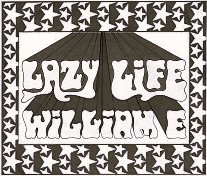
Single on Polydor, August 1967, by British singer-guitarist William E. Kimber, aka Bill Kimber. He also recorded on Parlophone as William E. Kimber in the late 60s and on Arista as Bill Kimber mid-70s.
His band Bill Kimber & The Couriers were from London but they worked in South Africa 1963-64. Their manager was Frank Fenter (1936-1983), a South African based mainly in London. He also managed British band Les Fleur de Lys whose bass player Gordon Haskell (1946-2020) wrote Lazy Life.
Essential reading: Definitive Gordon Haskell biography with images at Bournemouth Beat Boom.
See also GordonHaskell.com and the Gordon Haskell biography by Bruce Eder at All Music.
It was Frank Fenter who arranged for Bill Kimber & The Couriers to tour South Africa in 1963. They made a big impression as a fresh new British band in the emerging Merseybeat style, and stayed on 1963-64, recording for South African label Renown, and starring in Africa Shakes, a musical film co-written by Fenter.
Fenter was also an actor and music publisher, and from 1966 was a successful managing director of Atlantic Records in Europe.
References, further reading: 1. Bill Kimber & The Couriers discography at SA Rock Encyclopedia. 2.Bill Kimber & The Couriers at Old Melodies’ Music Archive blog. 3.Frank Fenter entry at Wikipedia. 4. Africa Shakes at SA Rock Encyclopedia and at IMdB. 5.Les Fleurs de Lys at The British Beat Boom [archived page]. 6.Gordon Haskell’s website. 7.Garage Hangover’s page on South African band The A-Cads touches on the history of Bill Kimber & The Couriers since Dick Laws of The Couriers returned to South Africa to join The A-Cads when they formed in 1965.
A footnote on Sharon Tandy: This highly-regarded soul-styled singer from Johannesburg (Sharon Finkelstein, 1943-2015) was associated with all the main players in the early history of Lazy Life. She was discovered and managed by Frank Fenter, and before moving to London in 1964 she toured and recorded with Bill Kimber & The Couriers and appeared in Africa Shakes. In London, Tandy and Fenter were married for a time, and she followed an acclaimed career that included releases on Pye, Mercury and Atlantic, singing with Fleur De Lys and recording at the Stax studios in Memphis. She returned to South Africa in 1970 where her recordings included dueting with Billy Forrest.
More about Sharon Tandy: 1. Alex Palao’s appreciation at Ace Records and his personal tribute to her. 2.Sharon Tandy entry at Wikipedia.
(Gordon Haskell) UK
Unreleased at the time; released later
Recorded late 1960s, unreleased until May 1984 on Magnum album Loving You.
This was a posthumous release from British rock star Billy Fury (Ronald Wycherley 1940-1983). The album collected tracks recorded for Parlophone, the label that signed Fury in 1967 after he had recorded for Decca since 1959. He had charted Top 40 around twenty-five times on Decca 1959-66, peaking 1961-63 with seven Top 5 hits.
Billy Fury was one of a number of British pop singers given colourful stage names by their manager Larry Parnes, among them Tommy Steele, Vince Eager, Lance Fortune, Marty Wilde and Georgie Fame.
… Billy Fury’s Parlophone era, with its quite particular take on orchestrated psychedelic pop and its real air of mystery, is a labyrinth worth getting lost in.
Bob Stanley
Essential reading:
1. Bob Stanley, “The other, later, stranger sound of Fury”, Record Collector #471, September, 2017, discusses reissues of the Parlophone material in the context of Fury’s wider career.
2. Liner notes to Loving You, readable in sleeve shot at Bear Family (resize using +/–).
Billy Fury singles discographies at Wikipedia and 45cat.com.
UK chart placings (Top 75): Billy Fury in British charts: The Guinness Book Of British Hit Singles (1981).
[Digitised copy at Internet Archive. This edition was published before two charting Parlophone singles in 1982, but it has a complete listing of Fury’s previously charting Decca singles.]
 Pop Archives
Australia's premier song history site since 2004
Website by Lyn Nuttall. © Lyn Nuttall 2004-2026. Chart positions courtesy of Gavin Ryan’s Australian Chart Books and Dean Scapolo’s Complete NZ Music Charts. Special thanks to Terry Stacey for information, corrections and suggestions. Thanks also to Tony Watson, Philippe Edouard, Dave Overett.., More…