(Ruth Lowe) Australia
#46 Sydney #10 Melbourne #13 Adelaide #38 Perth
Melbourne band Daddy Cool’s biggest hits were with original compositions, notably Eagle Rock, (Australia’s #1 single of 1971), but they found fame through their good-humoured reworkings of old songs like this one. The band shared a name with the song Daddy Cool, originally by The Rays (1957).
Although they were known as 1950s revivalists, Daddy Cool’s I’ll Never Smile Again is a take on The Ink Spots’ 1940 version.
See also: 1. Daddy Cool at Milesago. 2. DaddyCool.com.au
(Ruth Lowe) USA
USA
#107 USA
Single on Cub by East Coast doo-wop group formed in 1952 as The Barons, later known as The Larks and The Singing Wanderers. The Wanderers‘ biggest hits were For Your Love (1961, #58 Cash Box) and There Is No Greater Love (1962, #77).
♫ Listen at YouTube
Sources, further reading:
1. Wanderers biography by Bryan Thomas at All Music.
2. Marv Goldberg’s detailed page on The Wanderers is probably the definitive account of the group.
(Ruth Lowe) USA
#25 USA #48 Sydney
On album Remember When? January 1959, and on Mercury single July 1961.
The Platters were a chart-topping vocal group brought together in 1953 by arranger-composer-manager Buck Ram with lead tenor Tony Williams. Their numerous Top 40 hits began with Only You (1955, #5 USA) and included four #1s: The Great Pretender (1955), My Prayer (1956), Twilight Time (1958) and Smoke Gets In Your Eyes (1958).
I’ll Never Smile Again featured a new lead singer, Sonny Turner, after Tony Williams left for a solo career.
Reference: Jay Warner, American Singing Groups (2006), pp. 275-278.
(Ruth Lowe) USA
#21 USA
On 10″ 78 rpm disc, B-side on Decca by vocal and instrumental quartet that issued numerous popular records throughout the first half of the 1950s, beginning with (It’s A) Sin (1951, #4 USA) and including Stranger In Paradise (1953, #3), Three Coins In A Fountain (1954, #1), Melody Of Love (1955, #3) and Love Is A Many Splendoured Thing (1955 #1).
Leader Al Alberts left in 1958. Over the years, configurations of the Four Aces continued to perform, even compete, featuring new recruits or original members.
Al Alberts returned after pursuing a solo career and in 1975 his group legally won the right to use the name The Original Four Aces, Featuring Al Alberts. They continued performing until the late 80s.
* Retrospectively calculated chart placing from Joel Whitburn’s Pop memories, 1890-1954
Selected sources, further reading:
1. Jay Warner, American Singing Groups (2006), pp. 200-202
2. The Wikipedia article is especially good on the later line-ups and the legal decision.
(Ruth Lowe) USA
Influential version
10″ 78 rpm disc on Decca, August 1940.
Daddy Cool’s 1972 version of I’ll Never Smile Again is based on this arrangement, including the lead guitar line, the vocal backing, and the spoken interlude.
The Ink Spots were a hugely popular and influential black vocal group who began recording in 1935. Their biggest hit was the multi-million-selling If I Didn’t Care (1939), featuring their trademark sounds of Bill Kenny’s high tenor and the spoken interlude by Orville “Hoppy” Jones.
Recommended reading: Comprehensive Ink Spots history by Jack Hanna over several pages at Marv Goldberg’s R&B website.
(Ruth Lowe) USA
#1 USA*
10″ 78 rpm disc on Victor, June 1940.
See the listing at 45world.com for notes about recording session dates.
This was the hit version of I’ll Never Smile Again, Sinatra’s first hit record ever. He had joined Tommy Dorsey’s band officially in January 1940.
Frank Sinatra appeared in Las Vegas Nights (1941) singing I’ll Never Smile Again with Tommy Dorsey’s orchestra and The Pied Pipers. This appearance in a film, his first, was uncredited.
Ruth Lowe later co-wrote (with Paul Mann & Stephen Weiss) the song that became Frank Sinatra’s radio theme, Put Your Dreams Away (For Another Day) (1945).
* Retrospectively calculated chart placing from Joel Whitburn’s Pop memories, 1890-1954
How Did Tommy Dorsey Get That Song?
• Ruth passed a copy of the tune to a saxophone player in the Tommy Dorsey band, hoping to have Dorsey hear the tune. (Big Bands Database)
or
• Tommy Dorsey, who was appearing at the 1939 Canadian National Exhibition (CNE), heard a recording of [Percy] Faith’s [radio] performance and arranged for the song’s publication by Sun Music. (The Canadian Encyclopedia)
Sources, further reading:
1. Betty Nygaard King, “I’ll Never Smile Again” at The Canadian Encyclopedia.
2. Archived entry on Ruth Lowe from Big Bands Database.
(Ruth Lowe) USA
First released version
#16 USA*
10″ 78 rpm disc on Bluebird, released April 1940, also the earliest studio recording of I’ll Never Smile Again, from a 19 February 1940 session. Vocals by Ray Eberle.
The Glenn Miller Orchestra also broadcast I’ll Never Smile Again on 4 March 1940 from the Cafe Rouge of The Hotel Pennsylvania, New York City.
Other versions recorded in 1940 (sessions from May to September): Tony Martin With The Ray Sinatra Orchestra, Lang Thompson & His Orchestra, Gene Krupa & His Orchestra, Russ Morgan & His Orchestra, Ray Noble & His Orchestra, Eddy Howard, Dick Robertson & His Orchestra, Ginny Simms & Her Orchestra, Gene Autry, and Elvira Rios.
I’ll Never Smile Again has been recorded many times over the years, including versions by this more or less random sample: Fats Waller, Django Reinhardt, The Four Aces, Count Basie, Billie Holiday, Sarah Vaughan, Doris Day, Patti Page, George Shearing, Dave Brubeck, The Four Freshmen, Tab Hunter, Gogi Grant, Al Martino, Jo Stafford, Bobby Vinton…
* Retrospectively calculated chart placing from Joel Whitburn’s Pop memories, 1890-1954
References:
1. Label discographies and session dates at 78discography.com (the Online Discographical Project).
2. Glenn Miller broadcast date from J. David Goldin’s chronology at RadioGOLDINdex.
3. Versions listed at All Music.
(Ruth Lowe) Canada
Original version: performance on radio
In 1939 Toronto-born Percy Faith (1908-1976) was working as a conductor-arranger-broadcaster with the Canadian Radio Broadcasting Commission (CBC).
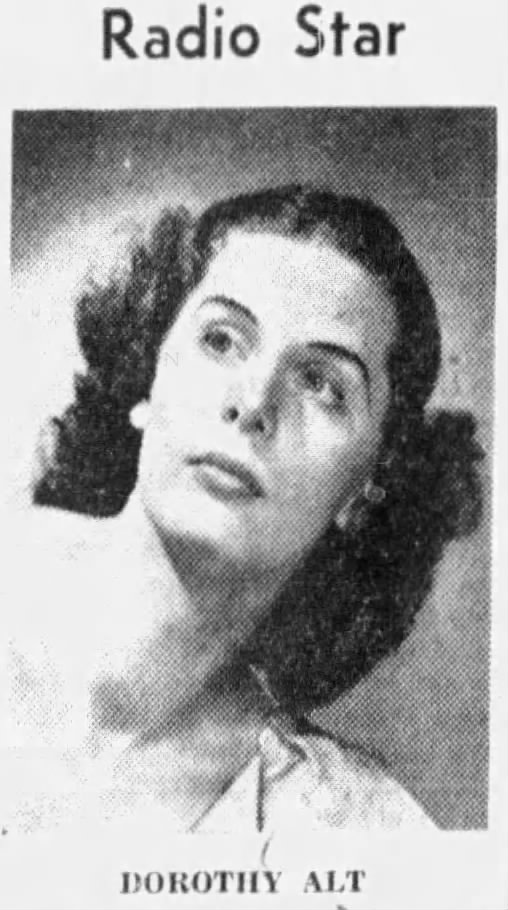
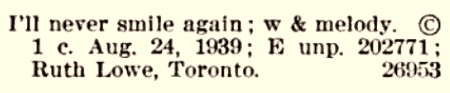
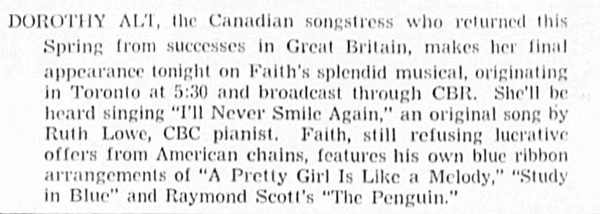
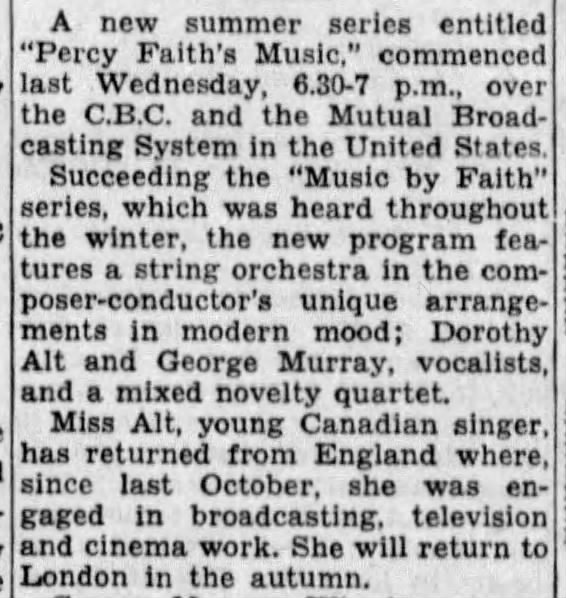
I’ll Never Smile Again was first heard publicly on Percy Faith’s Music, his networked summer program on CBC (listed by its winter title Music by Faith in some radio guides). Newspaper searches support a broadcast date of 30 August 1939, with vocals by Dorothy Alt, a regular with Faith’s orchestra. This was six days after the song’s US copyright date.
Percy Faith’s Music was also broadcast in the United States over the Mutual Broadcasting System, a large commercial radio network that included, for example, WOR New York.
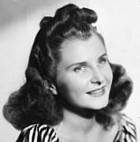
The song was written by Toronto-born pianist Ruth Lowe (1914-1982) after the death of her first husband, Herbert Cohen, a music publicist whom she met while touring with all-girl band Ina Ray Hutton and her Melodears.
Percy Faith would soon move permanently to the USA and wider fame as a conductor, composer, arranger, and recording artist at the Columbia label. He released dozens of instrumental albums, scored several films, and had some hit singles, for example with Max Steiner’s Theme From A Summer Place (1959 #1 USA, #2 UK).
Selected sources, further reading:
1. JR Hafer, “The Story of a Song”, detailed account at Grub Street.
2. Archived entry on Ruth Lowe from Big Bands Database.
3. Percy Faith and I’ll Never Smile Again at The Canadian Encyclopedia.
4. Percy Faith at Space Age Pop.
Thanks to Joop Jansen.
 Pop Archives
Australia's premier song history site since 2004
Website by Lyn Nuttall. © Lyn Nuttall 2004-2026. Chart positions courtesy of Gavin Ryan’s Australian Chart Books and Dean Scapolo’s Complete NZ Music Charts. Special thanks to Terry Stacey for information, corrections and suggestions. Thanks also to Tony Watson, Philippe Edouard, Dave Overett.., More…